.webp)



HaloITSM vs ServiceNow: Complete ITSM Platform Comparison 2026
Here's what most IT leaders get wrong about ITSM platforms: they think it's about managing tickets.
It's not.
Your ITSM platform determines whether your team drowns in support chaos or delivers seamless technical support. It shapes how fast you resolve incidents, how efficiently you handle changes, and whether your users trust IT or avoid it.
HaloITSM and ServiceNow both solve ITSM challenges, but they're built for entirely different organizations.
HaloITSM is the agile enterprise platform: delivering the scalability and performance trusted by Fortune 500 companies, but with the flexibility and transparent pricing that won't shock your CFO. It’s built for teams of any size, from ambitious SMBs to global enterprises, who need powerful ITSM without the typical enterprise overhead.
ServiceNow is the enterprise giant: a massive automation engine, unlimited customization, built for workflows across dozens of departments simultaneously. It's what Fortune 500 companies deploy when "good enough" isn't an option.
The question isn't which platform wins on paper. It's which one matches your actual situation. Your team's technical skills, your budget reality, your growth trajectory, and the complexity you're actually dealing with today.
.gif)
Let's break down exactly what each platform delivers.
HaloITSM vs ServiceNow quick comparison
While both platforms provide robust ITSM capabilities, they are engineered for different strategic outcomes and organizational profiles.
ServiceNow is the established enterprise standard, a powerful automation engine designed for organizations that require deep, complex customization across global operations. Its strength lies in handling intricate, multi-departmental workflows, but this power often comes with significant rigidity, long deployment cycles, and a high total cost of ownership.
HaloITSM is the agile enterprise alternative. Delivering the performance and scalability required for large-scale deployments without the typical enterprise overhead. It’s trusted by organizations ranging from ambitious mid-market companies to global enterprises needing a flexible, ITIL-aligned solution.
For example, its ability to support complex, high-availability environments is demonstrated in its successful deployment for Inlumi, which unified service delivery across multiple departments. This makes it a strategic choice for teams seeking faster ROI, especially those migrating from legacy platforms like ServiceNow to a more modern, cost-effective architecture.

.png)
Core module comparison table
.png)
Pros and cons snapshot
HaloITSM strengths:
Rapid Time-to-Value: Enterprise-grade deployments, including migrations from legacy systems, are completed in weeks, not quarters.
Lower Total Cost of Ownership (TCO): Transparent, all-inclusive licensing and minimal administrative overhead deliver predictable costs.
Flexibility and Agility: An intuitive, no-code platform empowers both IT and business departments to configure workflows without expensive consultants.
Enterprise-Grade Capabilities: Delivers the scalability, security, and performance required for large, regulated, and global organizations.
ServiceNow strengths:
Massive Platform Breadth: A comprehensive suite of tools covering ITSM, ITOM, ITBM, and beyond for deep enterprise transformation.
Extreme Customization: A powerful development environment for building bespoke applications and complex, cross-departmental workflows.
Global Scalability: Proven architecture to support hundreds of thousands of users across complex, multinational operations.
Vast Integration Ecosystem: A massive marketplace with connectors for virtually any enterprise system.
Who each platform best fits

The right ITSM platform isn't about features, it's about fit.
Your organization's strategic goals, technical resources, and operational complexity determine which solution will deliver the fastest ROI. Here's how HaloITSM and ServiceNow align with different enterprise profiles.
For Agile Enterprises and Mid-Market Leaders
HaloITSM is engineered for organizations from ambitious mid-market companies to global enterprises. Organizations that demand powerful, ITIL-aligned ITSM without the typical enterprise overhead. It’s for teams that value flexibility and rapid time-to-value as much as they do security and scalability.
While mid-market teams appreciate getting up and running in weeks, this agility is also why large enterprises are choosing HaloITSM. For example, Wolseley, an FTSE 250 company, successfully migrated from ServiceNow in just 10 weeks, demonstrating the platform’s ability to handle enterprise-scale requirements without the lengthy deployment cycles of legacy systems.
According to comparison data on PeerSpot, 100% of users of HaloITSM say they would recommend it, compared with ~91% of users of ServiceNow. (PeerSpot)
For Global Operations and Regulated Industries
ServiceNow has traditionally been the default choice for large, regulated enterprises due to its deep customization and governance features. This power, however, often comes with significant rigidity and a high total cost of ownership that requires certified partners for even minor changes.
HaloITSM presents the modern enterprise alternative, meeting stringent requirements for security, availability, and compliance without the legacy overhead. Its ability to support complex, high-availability environments is proven in its deployment for financial services firm Inlumi, which required unifying service delivery across multiple departments in a highly regulated context. This makes it a strategic choice for enterprises seeking faster ROI and a more agile operational model.
For Multi-Department Enterprise Service Management (ESM)
Enterprise Service Management (ESM) is about extending ITSM principles to departments like HR, Facilities, and Legal. While ServiceNow offers dedicated ESM modules, they often require separate licensing and complex configuration, extending deployment times significantly.
HaloITSM’s approach is more agile. It provides a unified platform where non-technical department heads can quickly configure their own service portals and workflows. This empowers departments to digitize their services in weeks, not quarters, fostering rapid adoption across the business. This capability was central to the successful ESM rollout at Inlumi, which streamlined processes for HR, Finance, and Operations on a single, intuitive platform.
Pros, cons, and user ratings

Marketing materials will tell you what platforms can do.
User reviews tell you what they actually do.
Here's what real IT leaders and their teams report after living with HaloITSM and ServiceNow daily: the wins, the frustrations, and the ratings that matter.
User satisfaction scores
Both platforms maintain strong ratings, but they excel in different areas that reflect their core design philosophies.
HaloITSM consistently scores high for ease of use, implementation speed, and quality of support. On G2, users rate it 4.8/5 overall. Teams praise how quickly they can get productive without extensive training.
iServiceNow is recognized for its vast feature set and enterprise capabilities. G2 users give it 4.4/5 overall. Gartner positions ServiceNow as a Leader for organizations requiring advanced automation and extreme scalability.
In Gartner Peer Insights, it holds a 4.6/5 rating from 164 verified reviews, while ServiceNow sits at 4.3/5 from a far larger enterprise user base.
The pattern is clear: HaloITSM wins on agility and user experience; ServiceNow wins on sheer platform breadth.
Top reported strengths
What users actually praise when they're not reading from a feature list:
HaloITSM strengths:
Rapid Enterprise Deployment: Go-live timelines are measured in weeks, not months, even for large-scale migrations from platforms like ServiceNow.
Intuitive No-Code Platform: Empowers IT and business admins to build workflows and configure the system without developer expertise.
Transparent, All-Inclusive Pricing: A predictable cost model delivers a lower total cost of ownership without surprise renewal fees.
Enterprise-Grade Security: Proven in regulated industries, meeting stringent requirements for security, compliance, and high availability.
Responsive, High-Quality Support: Users consistently praise the support team for its speed and effectiveness in resolving issues.
User-review data from GetApp lists HaloITSM with a “Value for Money” rating of 4.5 out of 5. (GetApp)
ServiceNow strengths:
Complex Workflow Automation: Handles intricate, multi-departmental processes with deep orchestration capabilities.
Massive Integration Ecosystem: Connects to virtually any enterprise system through a vast marketplace of pre-built connectors.
Executive-Level Reporting: Advanced analytics provide deep insights and compliance documentation for C-suite and board-level reporting.
Extreme Scalability: Seamlessly scales from thousands to hundreds of thousands of users in global deployments.
Advanced AI Capabilities: Predictive intelligence and generative AI features genuinely reduce manual work at scale.
Common user complaints
Every platform has trade-offs. Here's what frustrates users most:
HaloITSM challenges:
Focused Automation Scope: Prioritizes core ITSM/ESM automation over niche, complex orchestration to ensure faster deployment and ease of use.
Curated Marketplace: The integration marketplace is focused on essential business tools rather than offering thousands of niche apps.
Operational vs. Strategic Analytics: Reporting is powerful for IT operations but lacks the deep, predictive business intelligence of ServiceNow’s dedicated analytics modules.
ServiceNow challenges:
Steep Learning Curve: New administrators require months of formal training and certification to become proficient.
High Implementation & Maintenance Costs: Total cost of ownership is significantly higher due to long projects and the need for expensive consultants.
Pricing Complexity: Complicated licensing bundles and surprise true-up costs make budgeting difficult, especially during expansion
Upgrade & Customization Risk: Major platform updates can break existing customizations, requiring significant ongoing maintenance and testing.
On product review platforms, HaloITSM holds a user-rating of 4.6 stars (164 reviews) versus ServiceNow’s 4.3 stars (1,952 reviews). (Gartner)
The complaints reveal each platform's core trade-off: HaloITSM prioritizes agility and lower TCO. ServiceNow prioritizes comprehensive capability at the cost of complexity and expense.
Feature comparison across core ITSM processes
Features look impressive in demos. But what matters is how they perform when your team is drowning in tickets at 3 PM on a Friday.
Here's how HaloITSM and ServiceNow actually handle the ITSM processes your team lives in daily. The table below gives you a quick snapshot of the key differences:
.png)
Both platforms handle the basics well, but the depth and sophistication differ significantly. Here's how they compare across the ITSM processes your team uses every day in detail.
Incident and request handling
Both platforms handle the basics of capturing, routing, and resolving IT issues. HaloITSM uses a straightforward interface for ticket submission and management, with simple rules for routing that can be set up without coding.
ServiceNow includes advanced automation for ticket routing, using dynamic assignment rules and machine learning. The platform offers more configurable SLAs with complex escalation paths and custom notifications.
Key differences:
HaloITSM: Visual timers, clear status indicators, simple routing
ServiceNow: Machine learning routing, advanced escalation, workflow customization
Change and release workflows
Change management tracks and approves modifications to IT systems, like software updates or infrastructure changes. HaloITSM provides structured, ITIL-aligned forms for change requests, configurable approval routing for Change Advisory Boards (CABs), and integrated change calendars.
ServiceNow offers multi-stage approval workflows and detailed risk assessment with integrated impact analysis. Change tasks can be automated, and the platform supports advanced rollback planning and post-implementation reviews.
Asset management and CMDB
A Configuration Management Database (CMDB) is the operational core of any enterprise ITSM platform, storing information about hardware, software, and the relationships between technology assets.
HaloITSM provides a full, ITIL-aligned CMDB that allows teams to track assets, visualize dependencies, and assess the impact of changes. It maintains a complete asset inventory with fields for ownership, location, and lifecycle status, providing the data needed for effective incident, problem, and change management without the high administrative overhead of more complex systems.
ServiceNow's CMDB is a powerful, comprehensive system that supports advanced relationship mapping and automated discovery tools. These tools update asset records and dependencies in real time, enabling detailed impact analysis for global-scale environments. However, maintaining the health and accuracy of a ServiceNow CMDB often requires dedicated resources and significant investment.
For a deeper dive into asset management capabilities and how different platforms compare, check out our complete guide to asset management software platforms.
Self-service portal and knowledge base
Your users don't want to wait for IT. Nobody logs a ticket hoping to spend their afternoon hitting F5 on their inbox.
HaloITSM provides a clean, intuitive portal with straightforward search, category browsing, and guided request submission. The knowledge base returns relevant articles quickly, and admins can organize content without technical expertise.
ServiceNow's Service Portal offers extensive customization with AI-powered search, natural language processing, and Virtual Agent capabilities that resolve issues through conversational AI before tickets are created.
Key differences:
HaloITSM: Simple, fast, works immediately without customization
ServiceNow: Highly customizable, AI-enhanced, requires configuration effort
Reporting, dashboards, and business intelligence
Data without insights is just noise. Your ITSM platform should surface the metrics that actually matter, not bury them in complex report builders.
HaloITSM includes pre-built dashboards covering standard ITSM metrics: ticket volume, resolution times, SLA compliance, and agent performance. The visual interface lets IT managers and department heads see real-time performance at a glance, with customizable widgets and a straightforward report builder that requires no technical training.
ServiceNow provides enterprise-grade analytics with its Performance Analytics modules. The platform tracks trends, identifies patterns, and surfaces predictive insights using machine learning. Dashboards aggregate data across multiple departments, and the Report Designer supports complex queries for sophisticated business intelligence and C-suite presentations.
Key differences:
HaloITSM: Clear operational metrics for IT teams and department heads
ServiceNow: Strategic insights and cross-departmental analytics for executive reporting
AI, automation, and extensibility: pragmatism vs. platform

Modern ITSM is an automation and intelligence game. The platform that wins is the one that eliminates manual work, predicts issues, and empowers teams to build solutions themselves without waiting for developer resources.
This is where the architectural philosophies of HaloITSM and ServiceNow diverge most sharply. Both leverage AI and low-code, but for fundamentally different strategic outcomes.
Virtual agents and generative responses
Your users don't want to wait for IT.
End-users want immediate answers, not ticket numbers. The goal of AI in service management is to deflect tickets by resolving issues at the source.
HaloITSM's AI-powered chatbot and knowledge suggestions are engineered for immediate impact. It uses natural language processing to understand user intent, surface relevant knowledge base articles, and guide users through request submission. This pragmatic approach deflects common tickets from day one, a capability that large organizations use to reduce agent workload without a lengthy AI training project.
ServiceNow's Virtual Agent is a powerful generative AI engine designed for complex, multi-turn conversations. It can orchestrate backend actions like password resets and access provisioning. However, realizing this potential requires significant investment in data training, conversation design, and integration tuning, often extending the time-to-value.
Key differences:
HaloITSM: Pragmatic AI for immediate ticket deflection and faster ROI.
ServiceNow: Advanced conversational AI for complex, end-to-end resolution, requiring significant configuration.
The future of ITSM automation isn't just about chatbots; it's about agentic AI that actually thinks, decides, and acts independently.
Want to understand how AI agents are transforming service management beyond basic automation? Check out our complete guide on implementing agentic AI in ITSM and ESM.
Workflow builders and orchestration
The best automation empowers your team to solve its own problems without creating a developer bottleneck.
HaloITSM’s strength is its intuitive, no-code workflow builder. It uses a visual, drag-and-drop interface that allows both IT and business leaders to automate processes for routing, approvals, and notifications in minutes. This agility is an enterprise advantage, enabling a global firm like Inlumi to roll out ESM to multiple departments quickly and empowering Wolseley to migrate from ServiceNow in just 10 weeks.
ServiceNow's flow designer is a robust low-code orchestration engine capable of managing complex, multi-system processes. It’s built for scenarios like coordinating cloud resource provisioning with HR onboarding. This power, however, comes with a steeper learning curve and often requires administrators with specialized scripting skills or certified consultants to build and maintain workflows.
Key differences:
HaloITSM: Intuitive no-code automation that empowers IT and business teams to build and adapt quickly.
ServiceNow: Powerful, developer-focused orchestration for complex, cross-platform workflows.
ServiceNow is an uphill battle from day one.
The platform promises enterprise transformation, but getting there means climbing a steep learning curve, navigating complex configurations, and managing a deployment timeline that stretches months (sometimes years) instead of weeks.

For enterprises with the resources and patience to climb this mountain, ServiceNow delivers transformative capabilities at the summit. But the journey demands commitment, investment, and realistic expectations about what it takes to get there.
Predictive intelligence and analytics
Reactive IT is expensive. A modern ITSM platform must provide the intelligence to move from firefighting to proactive problem prevention.
HaloITSM provides powerful operational intelligence through its real-time dashboards and reporting engine. IT leaders can identify trends, analyze recurring incidents, and optimize resource allocation. Core functions for managing any large-scale service desk. The focus is on providing clear, actionable data that improves day-to-day service delivery.
ServiceNow’s Performance Analytics and predictive intelligence modules offer a different value proposition: strategic, C-suite-level forecasting. Using machine learning, it can predict major incidents, forecast SLA breaches, and model the business impact of IT changes. This strategic intelligence is powerful for organizations with dedicated data science teams, but it represents a significant step up in cost and complexity from operational reporting.
Key differences:
HaloITSM: Actionable operational intelligence for IT leaders to optimize service delivery.
ServiceNow: Strategic, predictive analytics for executive forecasting and risk modeling.
The AI gap between these platforms reflects their core philosophies. HaloITSM delivers pragmatic, enterprise-ready automation focused on immediate operational impact and ROI. ServiceNow provides a vast, resource-intensive intelligence platform aimed at long-term, top-down business transformation.
Pricing and total cost of ownership
The sticker price of an ITSM platform is rarely the final cost.
For a CIO, the real number is the Total Cost of Ownership (TCO), the three-to-five-year sum of licensing, implementation, certified consultants, dedicated administrators, and upgrade cycles. This is where HaloITSM and ServiceNow present two fundamentally different financial realities.
Licensing models: predictability vs. complexity
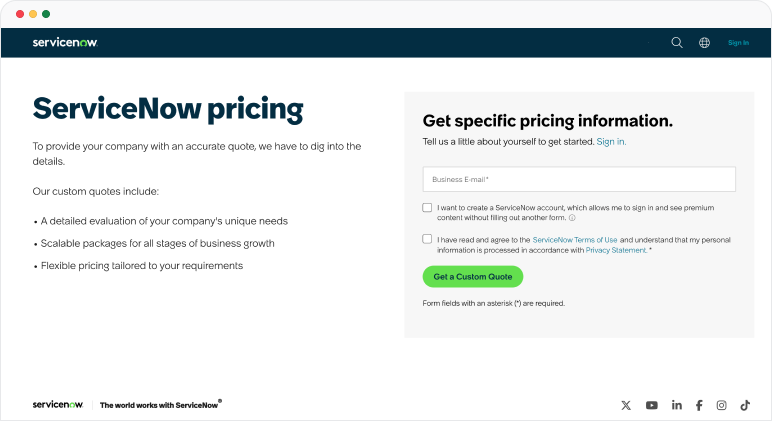
ServiceNow’s pricing is built for the traditional enterprise procurement cycle: complex license bundles, minimum seat counts, and annual true-ups that can introduce budget surprises. Unused licenses and features within these bundles typically expire, representing sunk costs.
Unused allowances? HaloITSM credits you back
Here's something most ITSM vendors won't tell you: you're probably paying for licenses, support hours, and consultancy time you never actually use.
HaloITSM offers a transparent, all-inclusive per-user model that scales from SMBs to Fortune 500 enterprises. There are no minimums, and the model includes a unique fairness guarantee: any unused license allowances, consultancy hours, or support usage are credited back at renewal. You only pay for what you actually use.
It's a simple idea: fairness.
HaloITSM flips that model. At renewal, they review your actual usage across licenses, support, and consultancy. Anything you didn't use? Credited back. Automatically. No negotiation required. No awkward conversations with account managers. Just fair pricing based on real consumption.
What gets credited:
Unused licenses: Paid for 100 seats but only averaged 80 active users? You get a credit for 20.
Consultancy hours: Bought a block of implementation hours but finished early? The remainder is credited back.
Support usage: Purchased premium support, but the platform was so stable you barely needed it? Your credit reflects your actual usage.
This isn't a promotional gimmick. It's how HaloITSM operates: transparent pricing, no vendor lock-in tactics, and a genuine commitment to charging customers fairly.
Implementation and maintenance: the hidden TCO
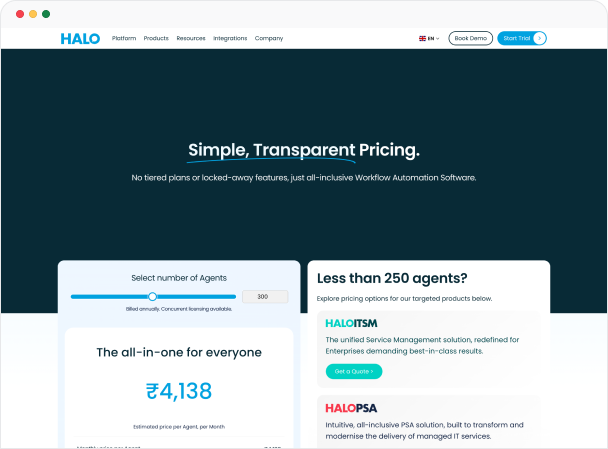
HaloITSM is engineered for rapid time-to-value, which directly lowers TCO. Enterprise-scale deployments, including complex migrations, are often completed in-house within weeks. For example, FTSE 250 company Wolseley successfully migrated from ServiceNow in just 10 weeks, a timeline that drastically reduces reliance on expensive external consultants. Post-launch, the intuitive, no-code platform requires minimal administrative overhead, with updates deployed automatically without breaking existing configurations.
A ServiceNow implementation is a significant capital project, often requiring 6-18 months and a team of certified partners. The platform’s complexity means that even minor configuration changes or routine upgrades can demand specialized developer resources, adding to the ongoing maintenance "tax" and technical debt.
Deployment speed, migration, and admin effort
Time-to-value is the ultimate measure of an ITSM platform’s efficiency. It’s the gap between signing the contract and seeing measurable improvements in service delivery. This is where the agile architecture of HaloITSM creates a distinct enterprise advantage over the monolithic structure of ServiceNow.
Typical go-live timelines
HaloITSM: Weeks, not quarters. Mid-market teams often go live in under a month. This agility also applies at scale; global enterprises like Wolseley migrate from legacy systems in under 10 weeks.
ServiceNow: Months, not weeks. A standard ITSM deployment typically takes 6-9 months. Enterprise Service Management (ESM) rollouts across multiple departments can easily extend beyond a year.
Another source reports that a typical ServiceNow implementation achieves ‘time to value’ in 6-9 months, even when using experienced partners and proven methodologies. (inry)
Data migration best practices
Moving from legacy systems is where implementations either succeed quickly or stall for months. The complexity of data migration depends on your current tools, data quality, and how much historical information you need to preserve.
HaloITSM simplifies migration with straightforward data import tools (CSV) that most teams can manage internally. The focus is on bringing over essential, clean data to get operational quickly.
ServiceNow migration is a more complex undertaking, often requiring certified partners to manage its intricate data model and preserve CI relationships. Success depends on extensive planning and data cleansing.
Migration success factors:
Clean source data before migration begins; garbage in, garbage out applies.
Start with essential data only; historical tickets older than 12 months rarely provide value.
Test migrations in sandbox environments before touching production.
Plan for parallel operations during transition to avoid service disruptions.
This is where AI-powered migration changes everything. Traditional data migration is manual, error-prone, and expensive, taking weeks or months with consultants mapping fields, transforming data, and fixing mistakes. saasgenie's migrategenie uses AI to automate the entire process: intelligent field mapping, data quality checks, relationship preservation, validation, and zero-downtime sync. Migrations that used to cost $50,000+ are now complete in days for a fraction of the price. Talk to our migration team about your current ITSM platform and target system.
Post-go-live support effort

Going live isn't the finish line. It's when the real work begins: training users, refining workflows, and keeping the platform running smoothly while your team adapts.
HaloITSM requires light ongoing support after deployment. A part-time administrator typically handles user questions, workflow adjustments, and routine maintenance. Training needs are minimal because the interface is intuitive, and most end users start submitting tickets effectively within minutes. IT staff usually become proficient with basic administration tasks within a few days of hands-on experience.
ServiceNow demands substantial post-deployment support. Organizations typically need dedicated administrators or managed service providers to handle ongoing configuration, troubleshooting, and optimization. Training requirements are significant: end users need structured onboarding to navigate the portal effectively, and administrators require formal training or certification to manage the platform competently. Many organizations underestimate this ongoing investment and struggle with adoption as a result.
Key differences:
HaloITSM: Minimal training, part-time admin sufficient, users productive immediately
ServiceNow: Formal training required, dedicated admin resources, longer adoption curve
Integration and marketplace ecosystems
Your ITSM platform doesn't exist in isolation. It needs to connect with Active Directory, sync with your monitoring tools, send alerts to Slack, and integrate with dozens of other systems your team relies on daily.
Integration capabilities determine whether your ITSM platform becomes the central hub for IT operations or just another disconnected tool. Here's how HaloITSM and ServiceNow handle the connectivity that actually matters.
Native connectors and APIs
HaloITSM provides native integrations with common business tools that mid-market teams use daily. The platform connects directly with Microsoft 365, Active Directory, Azure AD, Slack, and Microsoft Teams. Email integration works out of the box, and the REST API allows custom integrations for specific needs. The API documentation is straightforward, and most integrations can be configured without developer expertise.
ServiceNow offers an extensive integration ecosystem with pre-built connectors for hundreds of enterprise applications. The platform integrates natively with major cloud providers (AWS, Azure, Google Cloud), monitoring tools (Splunk, Datadog, New Relic), collaboration platforms (Microsoft Teams, Slack, Zoom), and virtually every enterprise system you can name. The IntegrationHub provides low-code tools for building custom integrations, and the REST API supports sophisticated automation scenarios.
Popular integrations comparison:
HaloITSM: Microsoft 365, Azure AD, Slack, Teams, Jira, and a robust REST API for custom needs.
ServiceNow: A massive library of connectors for virtually any enterprise system, plus an advanced orchestration engine.
Popular third-party apps
A platform’s marketplace reveals the health of its partner ecosystem. More apps mean more pre-built solutions, reducing the need for custom development.
HaloITSM's marketplace is curated, focusing on practical, high-value extensions for reporting, workflow automation, and key business applications. This approach reduces the noise and complexity of navigating thousands of apps, ensuring quality and relevance for both mid-market and enterprise teams.
ServiceNow's marketplace is massive, with thousands of certified applications for every conceivable industry and use case. While the breadth is unparalleled, the sheer volume requires significant effort to vet, procure, and maintain apps, adding another layer of complexity and cost to platform management.
Key differences:
HaloITSM: Curated marketplace with essential, high-quality enterprise extensions.
ServiceNow: Comprehensive marketplace with thousands of apps, requiring careful vetting and management.
Building custom extensions
When a pre-built connector isn’t available, your platform's extensibility determines whether you can build a solution or hit a dead end.
HaloITSM supports custom development through its modern REST API and webhook capabilities, allowing teams with standard web development skills to build the integrations they need. The architecture is straightforward, making it accessible without requiring platform-specific certifications.
ServiceNow is a full-fledged development platform. Its App Engine allows developers to build sophisticated, custom applications from the ground up. This power offers limitless customization but comes with a steep trade-off: it requires highly specialized, expensive ServiceNow developers and creates technical debt that can complicate future upgrades.
Key differences:
HaloITSM: API-first extensions using standard web development skills.
ServiceNow: A proprietary development platform for deep customization, requiring specialized expertise.
Security, compliance, and data residency

Security isn't a feature; it's a foundational requirement. For CIOs in regulated industries, a platform’s security posture, certifications, and data governance capabilities are non-negotiable.
Your ITSM platform is a repository for sensitive infrastructure and employee data. Here’s how HaloITSM and ServiceNow measure up on enterprise security and compliance.
Certifications and standards
Both platforms maintain core security certifications. HaloITSM’s enterprise-grade security architecture includes SOC 2 Type II and ISO 27001 certifications, alongside GDPR compliance. Its ability to meet the stringent requirements of regulated industries is proven by its successful deployment in the financial services sector with Inlumi.
ServiceNow holds a comprehensive suite of certifications, including FedRAMP for government agencies, HIPAA, and PCI DSS. It provides robust, industry-specific compliance frameworks and detailed audit trails necessary for large, heavily regulated enterprises.
Certification comparison:
HaloITSM: Holds essential enterprise certifications, including but not limited to SOC 2 Type II, ISO 27001, and is fully GDPR compliant, proving its suitability for regulated industries.
ServiceNow: Offers a comprehensive suite of certifications for complex compliance needs, including FedRAMP (government), HIPAA (healthcare), and PCI DSS (finance).
Regional hosting options
Data residency is critical for legal and compliance mandates. Organizations must ensure their data is stored within specific geographic boundaries.
HaloITSM offers data center options in North America, the United Kingdom, Europe, and Australia, allowing global organizations to meet their data sovereignty requirements.
ServiceNow provides an extensive global data center network, including dedicated government cloud instances (FedRAMP) and specialized hosting for different industries, supporting the most complex data residency strategies for multinational corporations.
Key differences:
HaloITSM: Regional hosting in key global markets to meet data sovereignty needs.
ServiceNow: Global data center network with government and industry-specific clouds.
Data protection features
Certifications are the starting point; daily security relies on robust data protection features like encryption, access controls, and monitoring.
HaloITSM provides the robust security controls expected by large organizations, including AES-256 encryption for data at rest and TLS 1.2+ for data in transit. It supports role-based access controls (RBAC), SSO via SAML, and comprehensive activity logging for auditing.
ServiceNow implements enterprise-grade security with advanced capabilities like multi-factor authentication (MFA), granular access controls, and a dedicated Security Operations module for threat detection and automated incident response. This makes it suitable for organizations with a mature security operations center (SOC).
Security features comparison:
Encryption: Both platforms use enterprise-standard AES-256 at rest and TLS 1.2+ in transit.
Access Controls: Both offer RBAC and SSO. ServiceNow adds more granular controls and native MFA.
Monitoring: Both provide full audit logging. ServiceNow offers an advanced SecOps module for threat intelligence.
Compliance: Both support regular security updates; ServiceNow provides industry-specific compliance tools
Five-point decision checklist for faster ROI
Comparison charts are useful, but strategic decisions are made by answering one question: which platform delivers measurable value faster for your specific situation?
Use this practical framework to evaluate HaloITSM and ServiceNow based on business outcomes, not just feature lists.
1. Total cost of ownership
Look beyond the license price. Calculate your three-year TCO, including implementation, training, ongoing administration, and the hidden costs of consultant dependency.
HaloITSM delivers a lower TCO because:
Transparent, all-inclusive per-user licensing.
Rapid implementation reduces consultant fees and internal resource drain.
Minimal training requirements save time and money.
A part-time administrator is often sufficient, even for enterprise teams.
ServiceNow’s TCO is higher, but may be justified by:
Deep automation capabilities that reduce manual work at a massive scale.
A single, comprehensive platform that can eliminate dozens of point solutions.
Extreme customization for unique, complex business processes.
Calculate your three-year TCO includes: Licensing, implementation, training, dedicated admin salaries, consultant fees, integration development, and upgrade management.
2. Time to value
How quickly will the platform solve your immediate problems and deliver measurable improvements?
Faster time-to-value means earlier ROI and less business disruption.
HaloITSM delivers value quickly:
Enterprise deployments are completed in weeks, not quarters, as proven by Wolseley’s 10-week migration from ServiceNow.
Users are productive immediately with an intuitive interface.
Pre-built templates and ITIL-aligned workflows accelerate configuration.
ServiceNow delivers transformation over a longer period:
Implementations typically span 6-18 months.
Requires a significant upfront investment in planning and configuration before value is realized.
Delivers compounding benefits over time through deep automation and platform consolidation.
Ask yourself: Do you need to solve urgent service delivery problems now, or can you invest in a longer-term transformation project?
On Capterra comparisons: HaloITSM user reviews show a starting price of ~£45/month (as listed) and a value-for-money rating of ~4-4.5 stars. (Capterra)
3. Scalability and flexibility
Will the platform support your organization's growth, or will you outgrow it? Consider both user scaling and functional expansion into other departments (ESM).
HaloITSM is proven to scale for enterprise needs:
Its architecture supports thousands of users and complex workflows, as demonstrated by its successful deployment at FTSE 250 company Wolseley.
Its flexible, no-code platform makes it ideal for agile ESM rollouts across HR, Facilities, and other business units.
It provides enterprise power without the rigidity, making it a strong fit for both growing SMBs and large corporations.
ServiceNow is built for massive, global scale:
Seamlessly supports hundreds of thousands of users across complex, multinational operations.
Handles intricate, multi-departmental workflows with deep orchestration.
It may be over-engineered and unnecessarily complex for organizations not operating at a massive global scale.
Consider: Your realistic 3-5 year growth trajectory. Choose a platform that fits your future state, not just your current one.
4. User adoption and training needs
A platform is only as good as its adoption rate. Ease of use for both IT staff and end-users is a critical factor for success.
HaloITSM minimizes adoption friction:
The intuitive interface requires minimal end-user training, driving rapid adoption and faster ROI.
IT staff become proficient with administration in days, not months.
Clean, modern design reduces resistance from non-technical users in other departments.
ServiceNow requires structured adoption planning:
Formal training and certification programs are necessary for administrators to become proficient.
End-users need guided onboarding to navigate the portal and services effectively.
Requires a significant change management investment to ensure successful rollout.
Evaluate honestly: Your team's technical sophistication and the organization's appetite for a steep learning curve.
5. Partner ecosystem strength
When you need help with implementation, customization, or ongoing support, the strength of the partner ecosystem matters.
HaloITSM offers responsive, expert support:
Combines a network of highly responsive implementation partners with world-class direct vendor support.
Customers are not forced to rely on expensive third parties for basic configuration or support.
An active user community provides valuable peer-to-peer advice.
ServiceNow provides an extensive global partner ecosystem:
Thousands of certified partners worldwide, including large global system integrators.
Specialized partners for every industry and technical need.
Managed service providers for ongoing administration
Partner quality and cost vary significantly, requiring careful vetting.
Consider: Do you prefer direct access to vendor experts, or do you require a large, global network of third-party consultants and managed service providers?
Get expert guidance with saasgenie
Selecting and implementing the right ITSM platform is a major strategic decision. saasgenie works with IT leaders to evaluate their unique requirements, compare options objectively, and deploy solutions that deliver rapid ROI.
Our certified HaloITSM experts help organizations navigate platform selection, handle complex data migrations, and optimize configurations for peak performance.
Ready to find the right fit for your enterprise?
Contact our team to discuss your ITSM requirements and get personalized recommendations.