.webp)
Agentic AI is redefining customer experience through autonomous systems that adapt to user needs in real time. Unlike traditional AI that follows predefined rules, agentic AI makes contextual decisions dynamically, enhancing personalization, efficiency, and satisfaction.
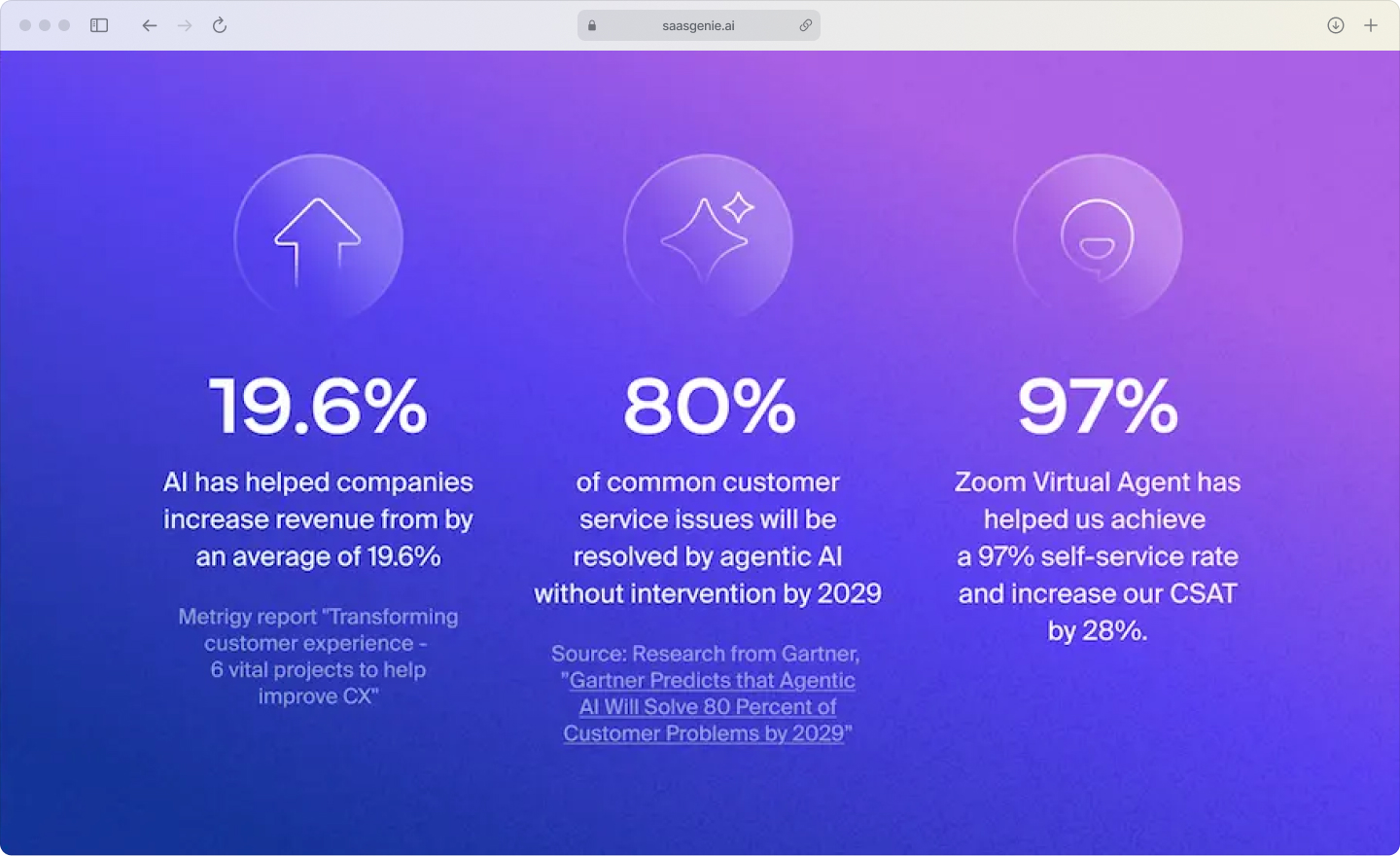
By 2029, agentic AI is projected to autonomously resolve 80% of customer interactions, that's 4 out of every 5, according to Gartner. Businesses are rapidly deploying agentic AI to revolutionize how they engage customers.
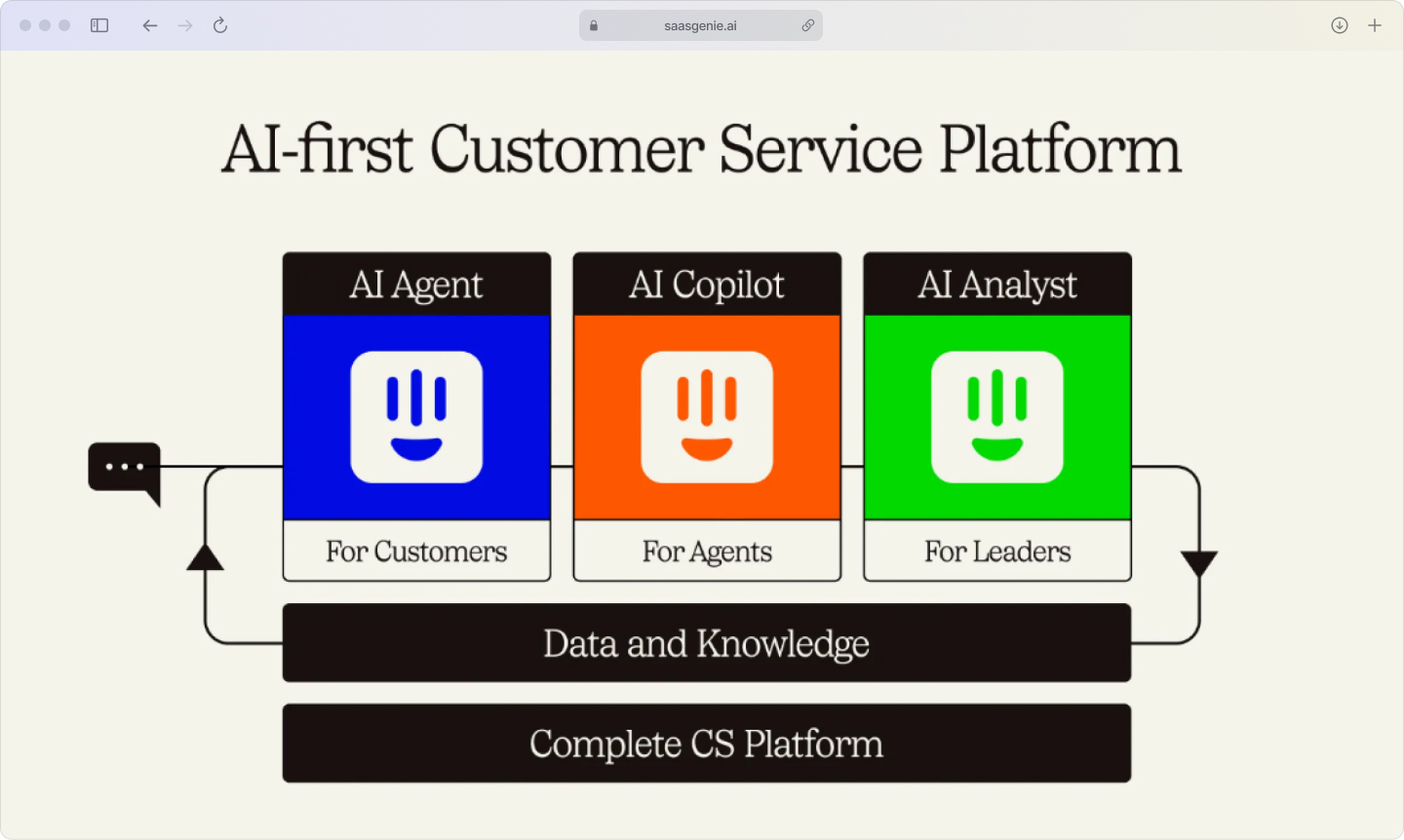
An AI agent is autonomous software that perceives its environment, processes data, and takes independent actions to achieve specific goals. In customer experience, AI agents analyze queries, make decisions, and respond intelligently, without human intervention.
Common examples include:
AI-powered chatbots
Virtual assistants
Predictive analytics systems
Not all AI systems operate equally. The key principles below define what separates a true AI agent from basic automation.
An AI agent is autonomous software that perceives its environment, processes data, and takes independent actions to achieve specific goals. In customer experience, AI agents analyze queries, make decisions, and respond intelligently, without human intervention.
Common examples include:
Not all AI systems operate equally. The key principles below define what separates a true AI agent from basic automation.
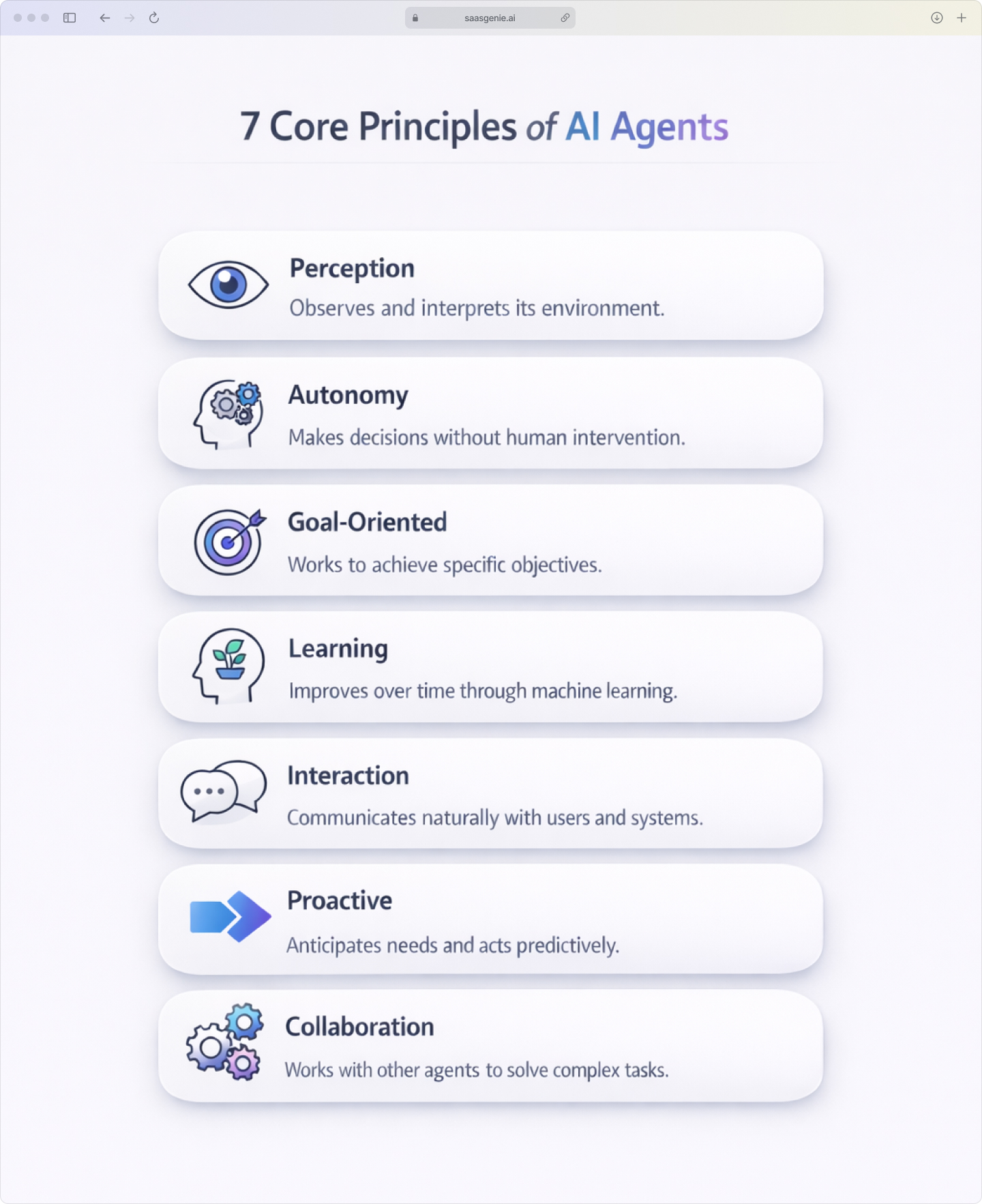
AI agents operate based on seven fundamental principles that determine their effectiveness in customer service, automation, and decision-making:
Here are the key principles that define AI agents:
1. Perception & Environment Awareness
AI agents observe and interpret their surroundings using data from multiple sources, such as user inputs, sensors, and databases. This ability to perceive real-world or digital environments allows AI agents to respond intelligently to dynamic scenarios.
Example: A virtual assistant analyzes user queries, tone, and past interactions to provide relevant recommendations.
Unlike traditional software, AI agents operate with autonomy, meaning they can analyze information and take actions without constant human intervention. They make decisions based on learned patterns, predefined objectives, and real-time inputs.
Example: AI-powered fraud detection systems automatically flag suspicious transactions without requiring human review.
AI agents are designed to achieve specific goals based on user needs, system objectives, or business functions. They continuously optimize their performance to meet these goals efficiently.
Example: A customer service AI agent aims to reduce response time while ensuring personalized support.
Modern AI agents leverage machine learning (ML) and deep learning to continuously improve. By analyzing past interactions and customer behaviors, they refine their responses and strategies over time.
Example: Netflix’s AI-powered recommendation engine learns from a user’s watch history to suggest personalized content.
AI agents are designed to interact naturally with humans or other systems. Through Natural Language Processing (NLP), speech recognition, and sentiment analysis, they facilitate smooth and intelligent interactions.
Example: AI chatbots handle customer queries by understanding tone, intent, and context, making conversations feel more human-like.
Unlike reactive AI, which waits for user input, Agentic AI proactively anticipates needs and takes action before a problem arises. This predictive ability enhances the user experience by reducing friction and resolving issues faster.
Example: AI-powered virtual assistants remind users of upcoming bill payments based on transaction history.
Some AI systems consist of multiple agents working together. These multi-agent systems communicate and cooperate to achieve complex goals more efficiently.
Example: AI in supply chain management uses multiple intelligent agents to track inventory, optimize shipping routes, and predict demand fluctuations.
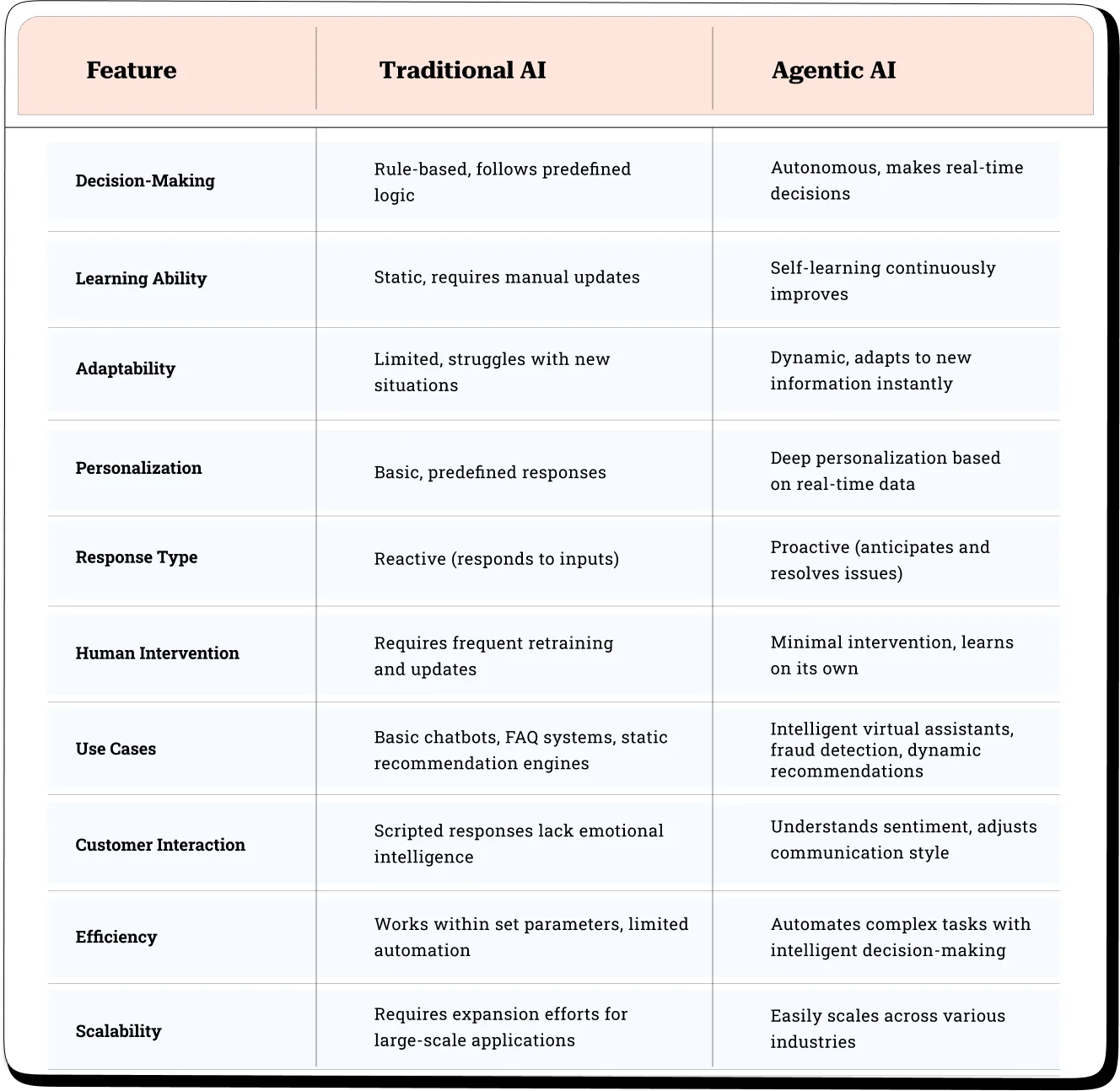
The key distinction lies in how an AI Agent operates, traditional AI follows predefined rules, while Agentic AI adapts, learns, and makes real-time decisions autonomously.
Let’s explore the fundamental differences between these two AI paradigms.
Traditional AI relies on static programming and predefined responses, making it limited in adaptability. In contrast, Agentic AI is a dynamic, self-learning system capable of making real-time decisions without human intervention.
Understanding these differences is essential for businesses looking to leverage AI for superior customer experiences.
The table below highlights the key distinctions between Traditional AI and Agentic AI.
Customer expectations are higher than ever, and businesses need AI-driven solutions that go beyond simple automation.
80% of companies using AI-driven CX report an increase in customer satisfaction, according to Gartner (2023).
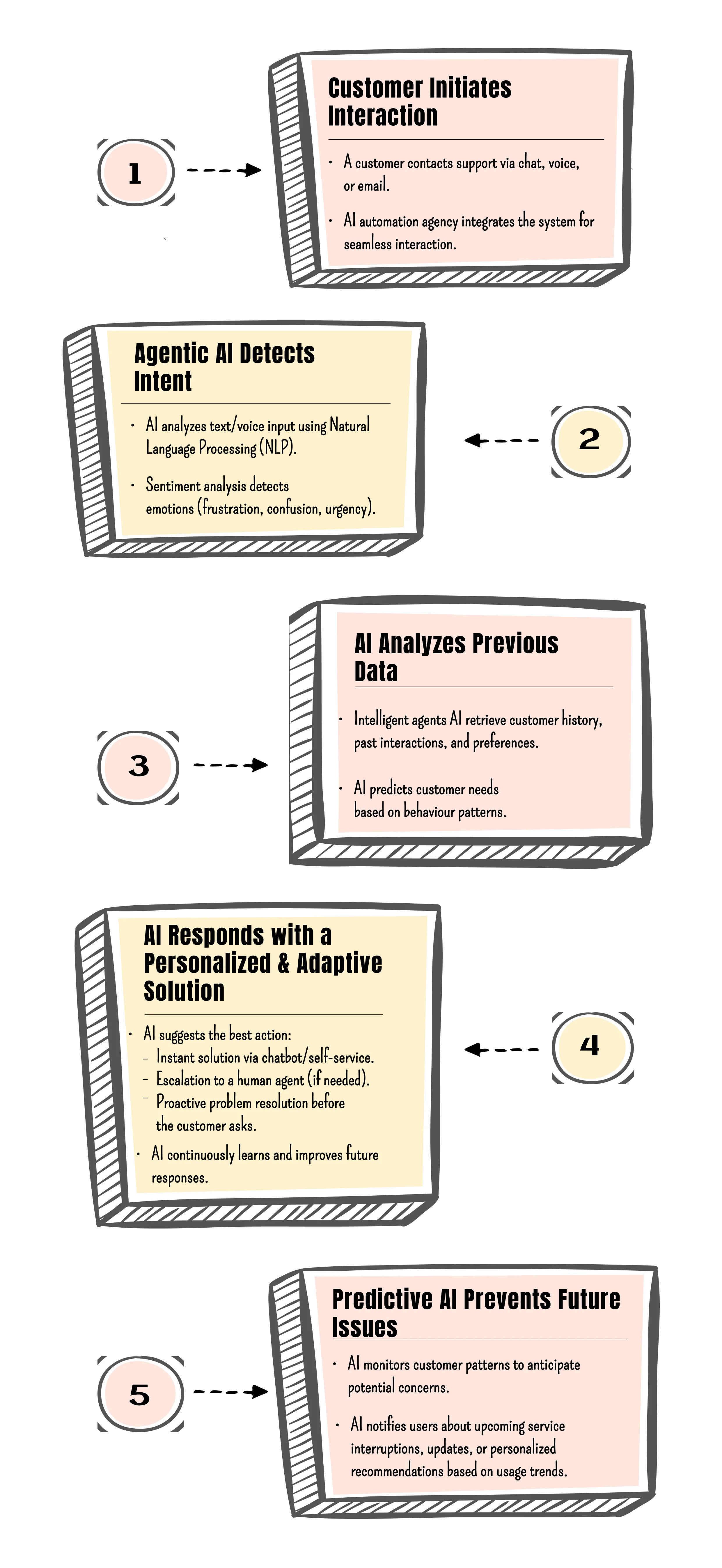
Agentic AI transforms customer interactions by understanding intent, learning from past behavior, and making real-time decisions to deliver hyperpersonalized experiences.
Unlike traditional AI, which reacts to inputs, Agentic AI proactively predicts customer needs and resolves issues before they arise.
Let’s explore how Agentic AI enhances customer experience across various touchpoints.
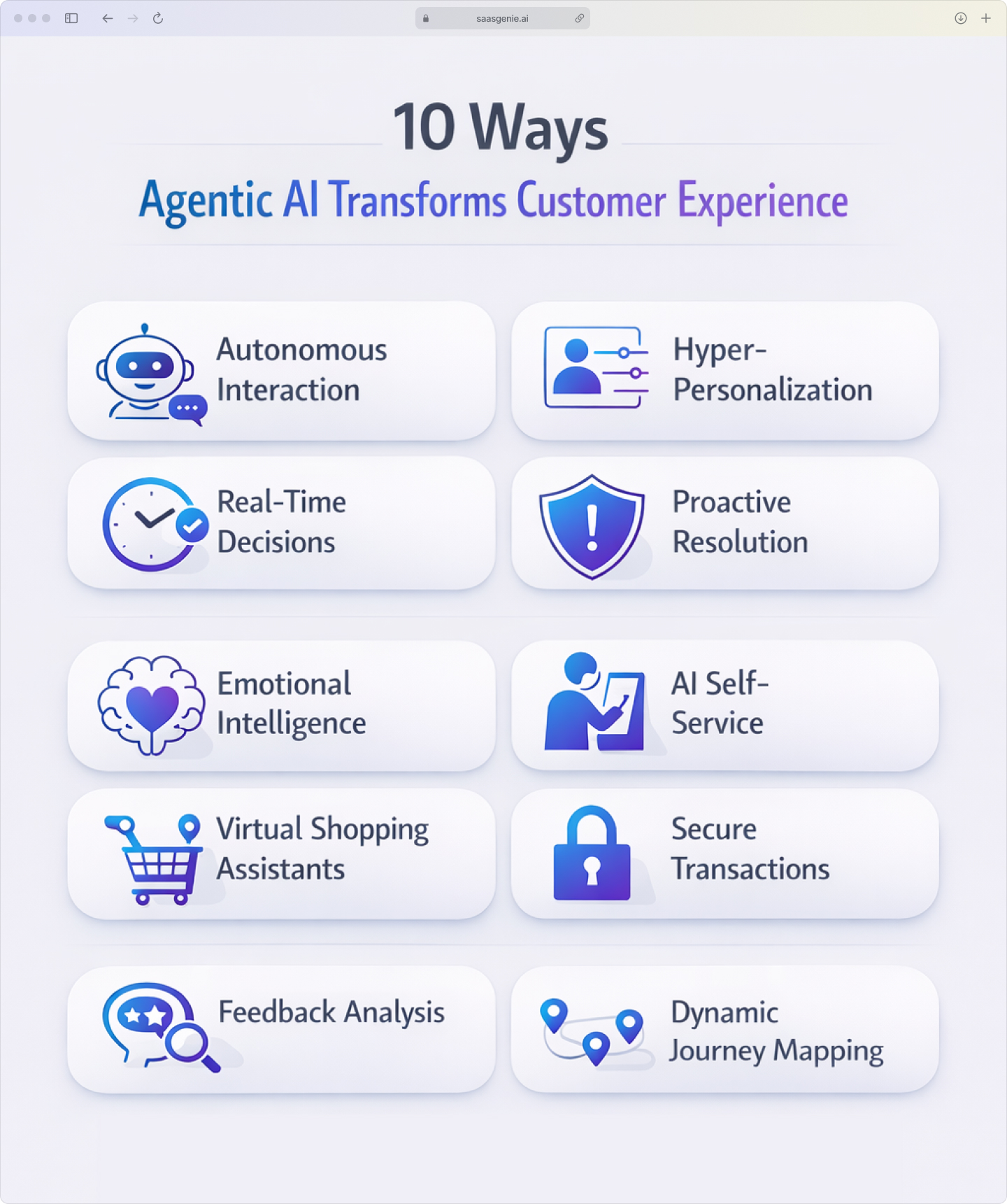
Agentic AI enables businesses to implement fully autonomous customer interactions.
Unlike traditional chatbots, intelligent agent AI solutions analyze past interactions, learn customer preferences, and adapt responses dynamically. This results in more human-like and intuitive interactions, allowing customers to receive accurate solutions without delays.
Example: Companies like Amazon and Google are integrating Agentic AI into their virtual assistants to improve conversation flow and decision-making, enabling real-time, meaningful engagement.
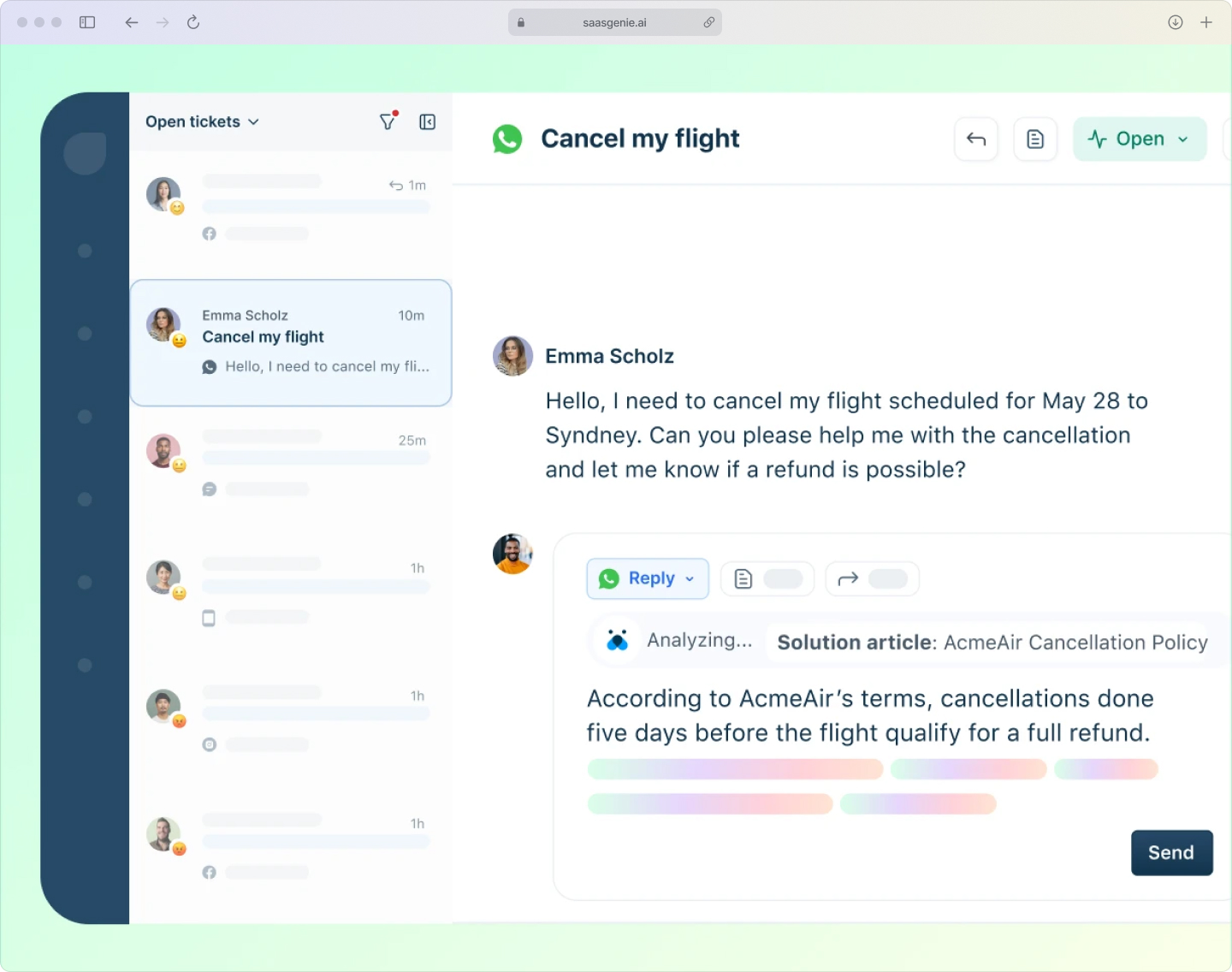
Traditional AI personalizes customer experiences based on predefined rules. Agentic AI goes further by continuously learning from new customer interactions.
Intelligent agents analyze:
This enables real-time, highly customized experiences, from product recommendations to tailored support.
Use case: E-commerce platforms like Shopify and Amazon use Agentic AI to predict customer needs. They offer hyper-personalized shopping experiences that evolve based on individual preferences.
Rule-based AI relies on predefined responses, limiting adaptability. Agentic AI solves this by making autonomous decisions in real time, assessing complex issues, retrieving solutions, and executing actions without human intervention.
Impact: Businesses can manage high-volume inquiries without overburdening human agents, improving response times and customer satisfaction.
Agentic AI doesn’t just respond to customer queries; it proactively anticipates problems and resolves them before they escalate. By analyzing data patterns, agentic AI predicts potential service disruptions and takes preventive measures. This results in a frictionless experience where customers receive solutions before they even recognize an issue.
Example: AI-powered banking systems detect unusual transactions and notify users before fraudulent activity occurs, securing accounts without requiring manual intervention.
Traditional AI struggles with understanding human emotions. Agentic AI enhances emotional intelligence by analyzing tone, sentiment, and behavioral cues. Intelligent agents in AI detect frustration, confusion, or dissatisfaction in real time and adjust their responses accordingly. AI automation agencies are integrating these capabilities to create empathetic and highly engaging customer interactions.
Advancement: AI-driven call centers now use sentiment analysis to adjust tone and messaging dynamically, improving customer-agent relationships.
AI-powered self-service platforms are evolving with agentic AI. Unlike basic FAQ bots, agentic AI enables fully autonomous troubleshooting, guiding customers through complex processes step by step. These intelligent agents AI dynamically adapt to customer needs, ensuring users receive accurate and relevant assistance without requiring human intervention.
Example: Tech companies provide AI-driven help desks where users receive immediate and evolving solutions without contacting support teams.
E-commerce businesses are leveraging agentic AI-powered virtual assistants to revolutionize the shopping experience. Unlike traditional recommendation engines, agentic AI understands customer preferences in context and provides highly personalized shopping guidance. AI automation agencies are using intelligent agents AI to create interactive and human-like virtual shopping assistants that engage customers at a deeper level.
Impact: AI-driven fashion assistants provide styling recommendations based on real-time analysis of customer preferences and shopping history.
Security remains a top priority in digital customer interactions. Agentic AI strengthens fraud detection by autonomously analyzing transaction patterns, identifying anomalies, and preventing fraudulent activities in real time. AI automation agencies are implementing these intelligent agent AI solutions to enhance cybersecurity while ensuring seamless transactions.
Use Case: AI-powered payment gateways now authenticate transactions by analyzing behavioral biometrics, reducing fraud cases significantly.
Agentic AI is revolutionizing feedback analysis by autonomously processing, categorizing, and prioritizing customer reviews. AI automation agencies deploy self-improving machine learning algorithms that detect trends, suggest actionable insights, and help businesses enhance customer experiences. Unlike traditional AI models, agentic AI continuously refines its understanding based on real-time feedback.
Example: AI-powered review aggregators analyze customer sentiment to help businesses refine products and services based on real-time user input.
Customer journey mapping is no longer a static process. Agentic AI continuously analyzes customer touchpoints, tracks interactions, and adapts strategies based on real-time engagement. AI automation agencies are integrating intelligent agents AI to optimize customer journeys dynamically, ensuring each interaction feels seamless, relevant, and highly personalized.
Impact: Businesses can refine marketing strategies dynamically based on AI-driven insights into customer behavior.
Benefits of Agentic AI in Customer Experience
Agentic AI delivers measurable advantages for businesses investing in CX transformation:
Agentic AI allows businesses to scale customer support without increasing headcount, enabling 24/7 availability.
AI automation agencies help companies reduce costs by replacing repetitive human tasks with customer experience automation..
Agentic AI minimizes errors in customer support interactions, leading to more reliable and trustworthy engagements.
Agentic AI is transforming sectors such as healthcare, finance, and retail by providing intelligent automation across industries.
Ensuring fairness and transparency in AI decision-making remains a critical challenge.
Businesses must safeguard customer data while implementing AI-driven solutions.
Companies need advanced infrastructure to integrate Agentic AI into existing customer experience systems.
Three trends will shape agentic AI's impact on CX:
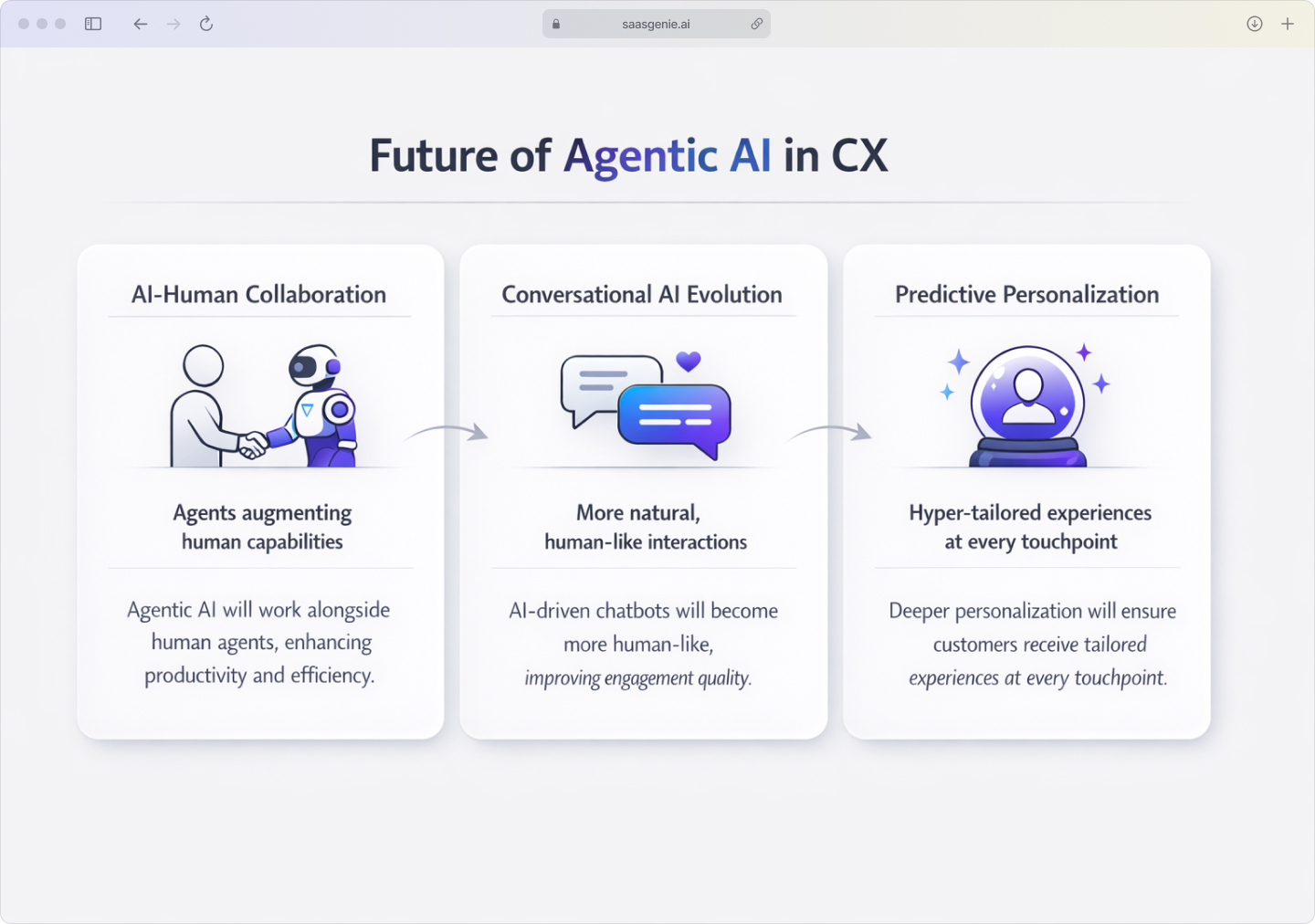
Agentic AI will work alongside human agents, enhancing productivity and efficiency.
AI-driven chatbots will become more human-like in their interactions, improving engagement quality.
Agentic AI will provide deeper personalization to ensure customers receive tailored experiences at every touchpoint.
Implementing agentic AI requires more than just technology. It demands a strategic partner who understands the nuances of customer engagement. At Saasgenie, we specialize in helping businesses deploy intelligent automation solutions that deliver real-world results.
Our experts work with you to:
Discover how to leverage agentic AI to reduce costs, increase customer loyalty, and drive business growth.
Agentic AI is transforming customer interactions through autonomy, adaptability, and contextual understanding. Businesses that embrace it will lead the future of CX, delivering unparalleled engagement and satisfaction.
As intelligent agents evolve, customer interactions will become more seamless, intuitive, and efficient than ever before. The time to invest in agentic AI is now.


